Slow, slower, slowest…

Hello all,

We know, freesound has been getting slower these days. But, help is along the way. Next week we will start initial testing of our brand new shining database server ( more about that later!). For those who like little graphics to spice up their daily lives, how about these. They represent the “server load” (how much the server is suffering) in the last year:

Our web server, doing relatively well:
http://iua-share.upf.edu/ganglia/?r=year&c=IUA&h=iua-freesound.upf.es

Our poor database server, slowly but very surely drowning:
http://iua-share.upf.edu/ganglia/?r=year&c=IUA&h=freesound-db.upf.es

You don’t need to be a genius to tell that that line is going up too fast for our own good. There’s just too many of you who want to use Freesound! Of course all of these problems will be solved with Freesound 2 a.k.a. Nightingale, but… we’re still heavy at work there. For now, switching to a new, shiny, 4 core, 14GB RAM machine will probably help. Again, more about those later! 😉

Your host for tonight,

– Bram

Posted in hardware, Tech Talk | 1 Comment

Nightingale possible design

Go over to http://www.freesound.org/forum/viewtopic.php?t=3542 and help us decide which logo to choose, and comment on a possible new design!

Posted in design, Nightingale | Leave a comment

Introducing Freesound Radio

Hi there. Freesound radio has now been installed on freesound:

http://www.freesound.org/radio/?

The?Freesound Radio is an experimental web-based system I’ve been working on ?at the MTG ?to experiment around collaboration and social interaction in sample based music creations, using freesound as the source of sounds.??The Sample Patch Editor interface allows you to put together short creations (sample patches) using samples?from the freesound?database.

?

??freesound radio editor?

?

?The?Player interface offers a meeting place to listen and interact with the existing creations of the users. By voting patches and bookmarking your favorite sounds and tags you collectively influence an evolutionary algorithm that continuously creates new patches by remixing and mutating existing ones.??

?

freesound radio player????

?

Both prototypes are now online and waiting for your contributions. ?Enjoy!?

Posted in freesound radio | Tagged , | 11 Comments

Dobroide and Reinsamb(r)a at National Geographic

Freesounder and pro sound designer Ron Sunsinger wrote me yesterday. He has used sounds from Dobroide and Reinsamba on the national geographic episode Man Made – Hi Tech Museum. And -like the license requires- both are credited. The episode aired in August and may air again soon! So keep an eye on the N. G. tv!

Row writes: “Here is a shot from my digital camera of my screen for the credit. Its a nice one, freesound has the first credit when the film is over [snip]. You can look on Nat Geo TV network site under Man Made for credits, but they take a while to get them up on the website.”

national geographic

Pity they got Reinsamba’s name wrong, but I’m sure he won’t mind 🙂

Special thanks to Ron for sending this in!

Posted in attribution | Leave a comment

Freesound teams up with Happy New Ears

A while ago Laura from Happy New Ears/Sonokids contacted me to see if we were interested in working together with them. Happy New Ears is a “new music” (lot’s of experimental things going on) festival in Kortrijk/Belgium.

She has proposed us to have the community of Freesound create sounds to load into the Omni (link in dutch, but with pictures) installation for kids and grownups all alike. It looks like a giant mushroom with buttons on top you can hit. If you hit a button a sound is played (see below for images). Of course we were immediately interested, and we hope the community likes the idea as well. Freesounds in a giant, colorful mushroom, being hit by kids? Talk about a psychedelic experience.

We’ve received some tech specs from the creators who have told us that sounds need to be shorter than 3 seconds, and need to be wav, 16bit, stereo. As you can see in the pictures the Omni has 108 pads, separated in 4 pizza slices of 27 sounds. I propose that anyone who wants to create sounds for the Omni creates 27 sounds, named 1 to 27, tagged with “sonokids-omni”, uploaded and added to one sound pack (so I can easily download them). Start counting at the top of the Omni-slice and go down in regular writing sense (i.e. 1, then 2,3, then 4,5,6,7, …). Deadline: 12th of September.

We will ask the people who built the Omni to cycle through the various packs during the 3 days the Omni will be accessible: September 19th, 20th and 21st.

( Photos ? Deen van Meer )

If you are from Belgium (or from around here), and provide some sounds, we will try to get you in for free. I’ll point Laura to this post and let’s see if she agrees to that. 🙂 Also, all sounds will be attributed on the day they are used. I.e. there will be a paper saying who made the sounds of the day!

Posted in workshops | 3 Comments

Prix Ars Electronica and Sons de Barcelona

We had known for a while, but were sworn to secrecy (queue spy music). Now that it’s out we can say it as well: we got an honorary mention at the very prestigious Prix Ars Electronica 2008! Our friends over at reactable (another UPF / MTG project) got the Golden Nica, the highest honor at ars electronica, for which we congratulate them and will give them a big hug next week!!!

Meanwhile we’ve started Sons de Barcelona, a local sound project concerning freesound, sounds in general and Barcelona. The focus of this project will be field-recordings in Barcelona, coupled with workshops for younger kids. If you read Catalan and/or are located in Catalunya, you should really have a look!

Posted in honors, sons-de-barcelona, workshops | Leave a comment

freesound.iua.upf.edu becomes www.freesound.org

After 3 years of using the rather long and confusing “freesound.iua.upf.edu” URL, we have finally convinced ourselves and the university that we needed a new domain. Starting effectively now, The Freesound Project get’s a new url:

http://www.freesound.org

(We will also stop refering to Freesound as “The Freesoud Project” but will rather switch to saying “Freesound dot org”.)

A few words about this domain name. After a long debate we decided we would buy the domain from buydomains.com. Buydomains.com (deliberately not turned into a link!) is one of those companies that makes money from buying domains on the web, holding them ransom and then selling them for a very high price. Depending on your view this might be called cybersquatting (although I don’t like the name as I have respect for squatters) or just plain extorsion: freesound.org was bought for the sum of 4073?.

Once Nightingale is up, we will have one of those nice “donate until we get to this sum” meters so the community can pay up to half of that. That way we can say that the Freesound.org domain is owned by the community. If we had done it the other way around (ask the community for half, then buy the domain), someone would have outsmarted us by buying the domain and increasing the price even more.

It was about time to make our support for Freesound even more official and give it an even stronger personality. We have also started a new initiative which will be hosted under the name http://barcelona.freesound.org/ and we are hoping that we will be able to start (or perhaps others will start!) other local initiatives related to sounds and sound recording. More news about barcelona.freesound.org soon!

Posted in Uncategorized | 8 Comments

Freesound seeks designer(s).

  • Would you like to help build Freesound 2.0 a.k.a. nightingale?
  • Do you have plenty of experience with making design for web and pouring that design into clean, validating xhtml and css?
  • Do you like the idea of having a link to your company or website on every page of freesound, visited by over 20000 unique people per day?
  • Do you have a visible online portfolio?
  • Are you able to do this for free (or almost for free)?

If you answered yes to these questions, contact me at bdejong@domain [where domain is iua.upf.edu] with subject: “I want to help with the freesound design!”

Posted in Nightingale | Tagged | 1 Comment

Testing Solr…

After looking around for a search engine for Nightingale, and comparing features between all the various ones (from using tsearch2 on postgres to Sphinx to Solr to …) I’ve settled on Solr. Configuring and running Solr was (much) easier than expected at the start. After about a day of hacking around, I got a nice tag-browser running, with Alax-ified searching through the tags. A bit more hacking around and I decided I would write a mash-up of all existing Python Solr wrappers. SolPython and solr.py, the one that’s included with Solr, seemed very unpythonic and little developed. PySolr on the other hand looked very nice, but there were some things in it I thought vould be better. Particularly, i wondered why the authors (two known Python/Django devs) used the XML parsing and didn’t use the JSON output. When you search in Solr, you can tell it to reply you in a number of output formats. They chose the XML output, I rewrote to use the JSON output, and allowed for more output parsers to be written / plugged in.

Neither Solr.py or PySol has classes for wrapping the search parameters. After reading through the docs I added a lightweight wrapper for a lot of the parameters.

We keep track of searches in freesound, so we can “replay” those searches for testing purposes, and after a bit of testing I found out some interesting things. Using Solr and a relatively heavy set of output features (I want to see a lot of “faceting”), I tested a batch of 100K searches. It looks like I can run 50 queries per second on my macbook pro. As the set of documents in Freesound is relatively small (“only” 50K sounds), everything fits very nicely in a very small cache (only 128MB), inluding all faceting data.

As before this source code is also open source, but -as Xavier gave me the go-ahead- this one is BSD instead og GPL. I will continue to release “support code” under the BSD license.

The code can be found here: http://iua-share.upf.edu/svn/nightingale/trunk/sandbox/solr/solr.py
The example code I used for benchmarking here: http://iua-share.upf.edu/svn/nightingale/trunk/sandbox/solr/freesound_test.py

Python/Solr people, feel free to send me any feedback!

Posted in Nightingale, Tech Talk | Tagged | Leave a comment

wav2png.py, son of wav2png

Last week I decided that for nightingale we need a new wav2png, and preferably one written in python, using the awesome python image library. After talking a bit to Ricard it was clear that using numpy and audiolab it would be a piece of cake. Well, a big piece of cake, but still. Once I got going, I went a bit overboard and decided that it would be nice to have a spectrogram of the sound as well, perhaps displayed when you move the mouse over the large image in the sound page.

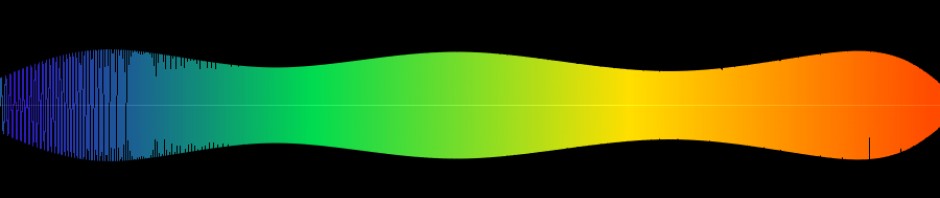
It took me about 2 and a half days of coding and testing to make it robust (it needs to work for 5-sample wave files and 5-million-samples wave files) and looking good. Some sensible feedback from the guys at oneDot.only made me decide that we had to cut back on the number of colors in the waveform view. The current one looks really ugly in my opinion, so… that was changes as well. It’ll take a while for people to become accustomed to the new colors, but it makes sense to me. I threw in some vertical anti-aliasing for that extra slick look.

For those who don’t know what a spectrogram is, have a look at the wikipedia entry for it.

Without further ado, I present you some results. First of all my own “test” file, a sinusoid sweep:

and its spectrogram:

An FM percussion loop from walkerbelm:

and its spectrogram:

A bell sequence from ERH:

and its spectrogram:

You can find the full source code to generate these images in the nightingale repository ( http://github.com/bram/freesound/tree/master ), in particular look in the directory /freesound/utils/audioprocessing/

You’ll need to install python, numpy, PIL and audiolab to make it work. See above for the links.

Let me know what you think!

Posted in Nightingale, Tech Talk | Tagged | 38 Comments